.png)
Why Sports Teams Are Consolidating Their Fan Engagement Tech, and What It Looks Like When They Do
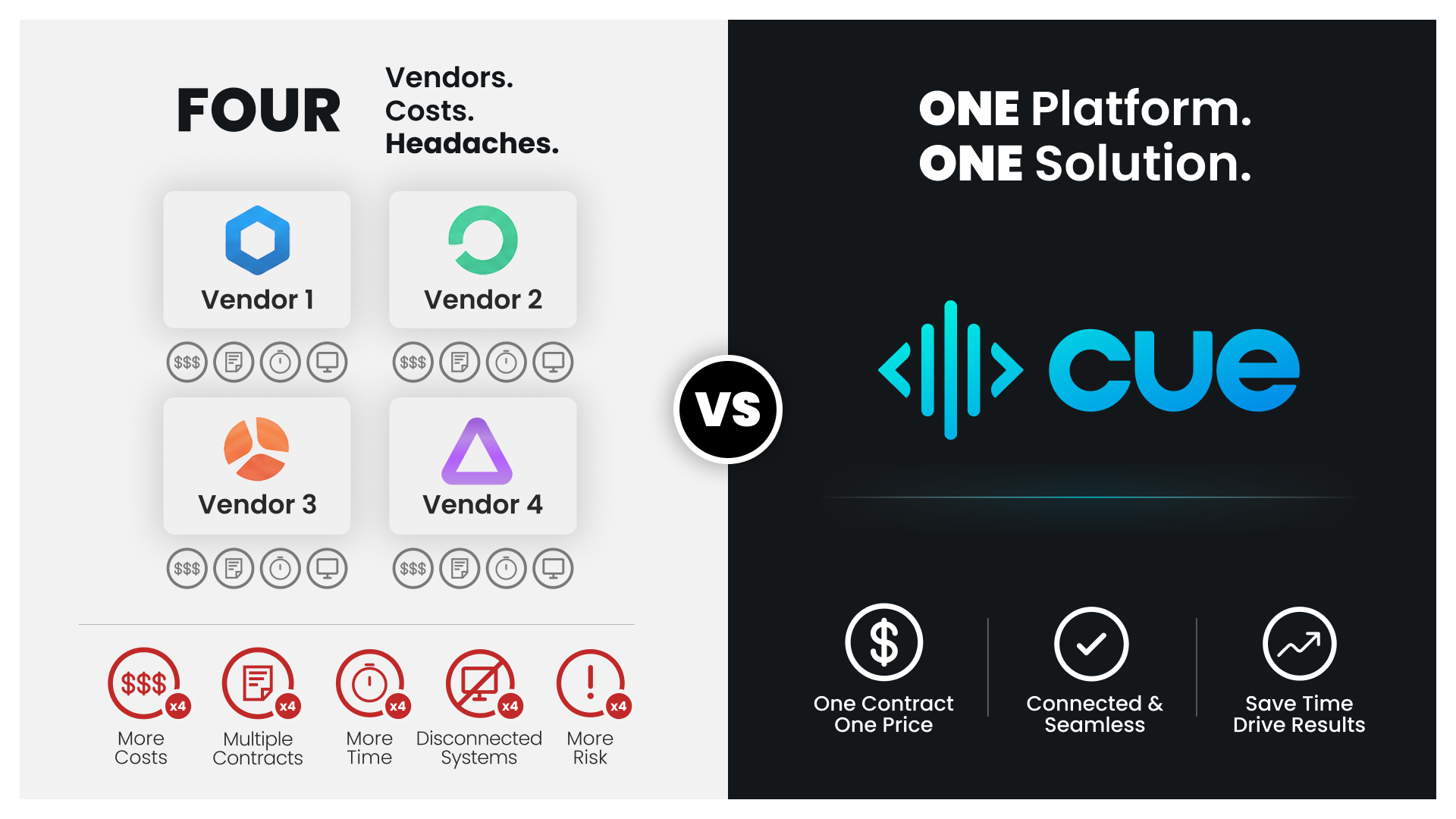
Walk into almost any sports organization today and you'll find a familiar pattern. The game presentation team has one vendor for fan engagement. Marketing has another for fan-generated content and digital experiences. Partnerships have another for sponsor activations. Somewhere in the middle, someone is trying to piece together a coherent story about sponsor ROI from three different datasets, three different workflows, and three different reporting systems, all designed to serve the same set of sponsors.
For years, that approach worked well enough. In 2026, it's becoming increasingly difficult to justify.
The shift changing how teams buy technology
The biggest change happening in fan engagement right now is not a new feature or a flashy new technology. It is a structural shift in how teams evaluate technology, and more importantly, how departments within an organization align around shared goals. Instead of stitching together point solutions for each use case, teams are consolidating onto platforms that serve multiple departments, multiple objectives, and multiple stakeholders at once.
It is not happening because consolidation is trendy. It is happening because the fragmented approach stopped delivering what sponsors need, what analytics teams need, and what operations teams can manage at scale. At the same time, organizations are being asked to prove ROI, activate first-party data, and do more with leaner internal teams.
The Hidden Cost of Fragmentation
The cost of multiple platforms isn’t just financial. Every additional vendor means another tool to learn and manage, another support team to contact, another game-day workflow to manage, another reporting system to navigate, and another platform employees must be trained to use.
The larger cost, however, shows up during sponsor renewals. Sponsors no longer ask how many fans saw a logo. They want measurable engagement, meaningful interactions, first-party data, and evidence that an activation influenced fan behavior.
When every department uses different technology, each platform tells only part of the story. Someone must combine those reports into a narrative that proves ROI—and even then, important pieces are often missing.
The real problem is not a technology problem
Here is what most teams eventually realize: they do not have a sponsorship problem, a marketing problem, a fan engagement problem, or a data problem. They have a fragmentation problem.
When Partnership Sales sells a sponsorship, Marketing executes it, Digital creates content around it, Game Presentation brings it to life in the venue, and CRM is supposed to activate the data on the back end, each group is often working from a different vendor, a different dataset, and a different workflow.
The activation belongs to everyone, but no one has the full picture.
That is what makes it so hard to report results. And that is why the teams getting ahead are not just looking for better tools. They are looking for shared platforms that let multiple departments work toward the same outcomes at the same time.
What Consolidation Looks Like
This is exactly the shift CUE was designed for. Rather than building a collection of disconnected fan engagement products, CUE was built as a unified platform where every activation shares the same foundation.
Whether it's interactive games, fan-generated content, light shows, AI-powered experiences, or sponsor activations, every product uses the same participation engine, reward system, reporting framework, and CRM integrations. That means teams can deploy individual experiences or connect multiple activations into one seamless fan journey.
Imagine a Coca-Cola sponsorship that begins with an interactive game before the event, continues with branded content on the videoboard, rewards fans at concessions, powers a Light Show during a key moment, and extends onto social media after the game.
Instead of managing multiple vendors and collecting separate reports, every interaction is tracked through one platform. Participation data flows into a single reporting environment and can be delivered directly into the organization's CRM, creating a complete view of fan engagement instead of isolated snapshots.
Today, more than 150 professional sports organizations and hundreds of NCAA programs use CUE to create connected fan experiences while heling organizations create connected fan experiences without adding more platforms to manage.
What it looks like in practice
For teams that have already made the move, the difference shows up across the organization at once. Partnership Sales has better inventory to sell and real activation data to bring to renewal conversations. Digital has content and interactive moments built in. Game Presentation has experiences that drive participation from tip-off to the final buzzer. CRM has first-party data flowing in automatically. And leadership has one platform, one contract, and one report instead of several.
Consolidation is not a compromise. It is not a smaller version of what teams had before. It is what happens when the right departments align around shared outcomes and the right platform makes that possible.
A note on what consolidation really means
Consolidation does not always mean finding a single vendor that does everything. For many organizations, it means being more intentional about choosing partners that work well together, share data openly, and make it easier to produce consistent, sponsor-supported content across live productions and digital channels. The goal is alignment: for fans, for sponsors, and for every department that is working toward the same game day.
If your organization is managing multiple vendors, multiple reports, and multiple conversations that should all be telling the same story, it is worth asking what is getting in the way.
Book a demo to see how CUE brings fan engagement, sponsorship, and data together on one platform.
.png)
CUE Platform Update: Fanimation, PostUp Face Fusion, and Look-A-Like Cam
.png)